Follow the Lines: How Timber Grain Decides What a Board Can Do
Photo: R6, State & Private Forestry, Forest Health Protection, Public domain, via Wikimedia Commons
Walk into any woodyard and you will see stacks of boards that look much of a muchness. Same species, similar size, roughly the same colour. Then you turn one over, look at the end, and the grain tells you a different story. It tells you how the log was cut, how the board is likely to move, and where it will fight you when you saw, screw or plane it. None of that is mystical. It is just tree growth plus a sawmill, and it is free information if you know where to look.
Start with the end grain
The end of a board is a cross-section of the tree, and it is the quickest way to read what you have bought. Look at the growth rings. If they sweep across the width in wide arcs, you are probably looking at a flat-sawn board, sometimes called through-and-through. If the rings stand up more vertically, close to the edge, that is quarter-sawn or rift-sawn stock. If the rings circle a pith near the middle, you have a boxed heart board.
That matters because each cut behaves differently. Flat-sawn boards give you wider faces and the cathedral figure that many people like on oak or pine. They also move more across their width as moisture changes. Quarter-sawn boards cost more and produce narrower widths, but they are steadier, with straighter lines on the face. Boxed heart boards can be perfectly useful, but the pith is a weak point and they are more prone to splitting down the middle.
What the face and edge are telling you
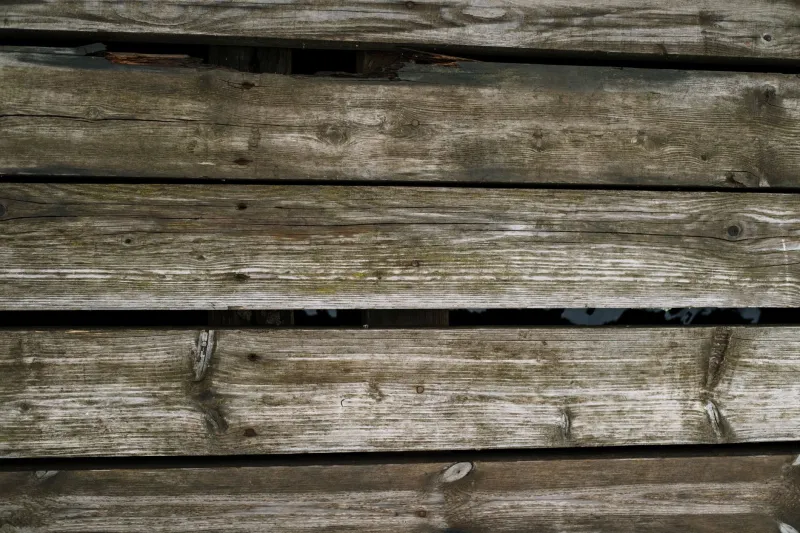
On the face, flat-sawn timber usually shows arches or cathedrals. Quarter-sawn timber shows more parallel lines. Neither is better in every case; they are just different tools for different jobs. The edge matters too. Look for grain that runs out to the side of the board rather than continuing along its length. Runout is where the fibres are cut short, and it is a weak spot. A little runout near an offcut is harmless. Runout through a tenon or a screw fixing is asking for trouble.
Knots are part of the picture as well. Grain has to divert around a knot, so the fibres are not running straight through that area. In graded structural timber, knots are allowed within limits. In joinery, you can be fussier. If a big knot sits near an edge or right where you plan to cut a joint, put that board back on the stack.
Movement is not a fault
All timber moves as it takes on or gives up moisture. A flat-sawn board moves more across its width than a quarter-sawn one. In a UK house, central heating dries timber out; in a shed or garage, it can swell again. That is why a wide shelf cut from a flat-sawn board may cup, while a narrower board or a quarter-sawn one is more likely to stay put.
You cannot stop movement, but you can plan for it. Let timber acclimatise in the room where it will live before you cut it. Mark the heart side so you can keep it consistent. When edge-jointing boards for a tabletop or shelf, alternate the heart side up and down so the cupping tendencies balance each other. Leave a little room for expansion at ends and edges. And do not clamp a board so hard that it splits when it dries.
Match the cut to the job
For shelving, stability matters more than figure. A wide, flat-sawn shelf may look lovely on day one and cup by next winter. Quarter-sawn timber, or narrower boards joined together, is the safer choice. Keep the grain running along the length of the shelf and put the stiffest face where it will be seen.
For framing, use graded structural timber and respect the grade. Grain slope and knot limits are part of what makes a stud or joist strong enough. Do not substitute a random pretty board for a graded one just because it looks straight. If you are notching or drilling, keep the cuts away from the tension edge and do not make them bigger than they need to be.
For joinery, read the grain before you mark out. Tenons want straight grain running their length, not short grain that will snap. Legs and stiles look better and perform better when the grain runs cleanly from top to bottom. At a joint, try to match the grain across the two pieces so the finish does not jump. On show faces, choose the side you want to look at and keep the same face outward throughout the job.
Cutting without tearout
A saw cuts cleanly when it is working with the grain, and roughly when it is working against it. Crosscutting is different from ripping, and end grain is different again. Support the offcut so the fibres do not tear away at the end of the cut. Score the line if you are using a handsaw. Use a backing board when drilling or sawing end grain. When planing, try one direction; if the surface tears, turn the board around and plane from the other end. Grain can reverse around knots, so you may need to change direction mid-board.
Sanding is the same story. Work along the grain, not across it. If you raise the grain with a water-based finish, dampen the surface lightly, let it dry, and sand again with a fine grit.
At the woodyard
Take your time at the stack. Sight along the board for twist, bow and cup. Look at the end grain. Check the face and the edge. Ask how the timber has been stored. A board that has been sitting in a puddle will tell you soon enough. If you need quarter-sawn stock, ask; not every yard keeps it in every size, but a decent local supplier will tell you what is on the rack.
Grain is not decoration. It is a map of how the board was cut and how it wants to behave. Read it before you cut, and you will spend less time fighting splits, twists and finishing problems later.