Holding Back the Garden: Where a Sleeper Border Ends and a Retaining Wall Begins
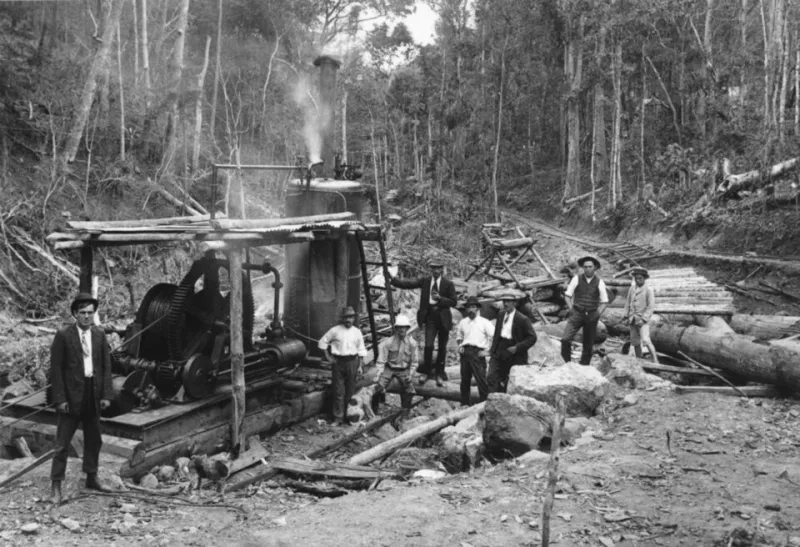
Photo: Unknown, Public domain, via Wikimedia Commons
There's a familiar photo on a lot of phones: a garden on a slope, a couple of courses of sleepers stacked on edge, and a caption about getting it done over a weekend. Sometimes it works. Quite often, two winters later, the same sleeper wall is leaning into the lawn and the owner is back at the yard asking for more timber to prop it up. The timber was never the problem. The job was.
A border and a wall are different animals
A sleeper on edge holding back 300mm of soil in a raised bed is a garden edge. It's doing a small job: keeping a bit of soil where you put it, tidying a level change, giving a planter some height. It doesn't need an engineer, and a decent piece of treated timber will usually see it out.
A wall retaining a metre of ground is a structure. It's carrying the weight of everything behind it, plus whatever the weather adds, plus anything parked on top of it. The difference isn't the material. It's the load. And load is the bit that gets skipped when the project gets described as 'just a sleeper wall'.
What soil actually weighs
Dry-ish soil sits around 1.6 to 1.8 tonnes per cubic metre. Wet soil is heavier, closer to two. Clay is heavier again and it doesn't drain, so the water that falls on the garden behind the wall has nowhere to go but into the soil and then against the timber.
Do the rough sums on a one-metre-high wall, ten metres long, with a metre of soil behind it: you're looking at something in the region of twenty tonnes of material the wall is quietly holding. Add a shed near the top, a patio, a path, or the family car reversing up to the edge, and that's a surcharge on top. Sleepers are good at a lot of things. Carrying twenty tonnes with butted joints and no toe is not one of them.
Drainage is the whole job, not a detail
The single most common reason a timber wall fails early is water. Saturated soil is heavier, it pushes harder, and it finds every gap. A wall with clay backfill and no drainage is a dam pretending to be a retaining wall.
If a wall is properly designed, the detail behind it usually includes clean granular backfill rather than the spoil from the hole, a perforated pipe at the base, a geotextile to stop the fines clogging it, and a fall so the water has somewhere to go. Weep holes through the timber at low level help, but they don't replace drainage behind the wall. People often backfill with the clay they dug out because it's free and it's right there. That's the choice that shortens the wall's life the most.
The sleeper itself: what it's actually sold for
Most of what we sell as sleepers is ground-contact landscaping timber. New softwood sleepers are incised and pressure-treated to a ground-contact standard, which is what you want if they're sitting in soil. Reclaimed railway sleepers are often creosote-treated, which is effective but has its own story: the treatment is restricted in the UK, the smell lingers, handling needs gloves, and they aren't the right thing next to a vegetable bed. Hardwood sleepers last well but cost accordingly.
None of that makes a sleeper a structural retaining element. It makes it a durable lump of timber. Those are not the same product with the same job description, and the label doesn't come with a design.
The tell-tales to look for
A wall that's struggling usually tells you before it goes. Look for a lean at the top, a bulge in the middle, joints opening up, or posts starting to rotate. Look behind the wall for cracked paving, a dip in the lawn, or soil slumping. Look for damp patches on the face, or a fence line that's suddenly leaning in sympathy. On a house wall nearby, sticking doors and new cracks are worth taking seriously.
Some of that can be caught early and put right. Much of it can't, because by the time the wall is leaning, the ground behind it has already moved. Propping a failing retaining wall with another sleeper is one of the few jobs where the cheapest fix is the one that costs the most later.
Where we stop and say get an engineer
We like selling timber. We like it more when the customer comes back for a shed, not for a remedy. So there are jobs where the honest answer at the counter is that this needs a structural engineer, not another three sleepers.
That's generally when the retained height is over about 600mm to a metre; when there's sloping ground above the wall; when the wall is close to a boundary, a building, or a neighbour's land; when the ground is heavy clay; when there are trees nearby pulling moisture out of the soil; or when anything is going to be built or parked behind it. Local authorities often want to see calculations for retaining walls above a certain height, and a designer will tell you what that means for your site. We can't sign that off from the yard, and you shouldn't want us to.
If it really is just an edge
Low garden edges, raised beds under a few hundred millimetres, stepped planters on a gentle slope: these are well within what a decent treated sleeper will do. Do them properly. Set them on a compacted base, keep the joints tight and staggered, fix them rather than just stacking them, line the back with a geotextile, use granular backfill, and leave a way for water to get out. Cap the top if it's somewhere you'll sit or walk. Then leave it alone and check it once a year.
That's a border. It'll hold soil, it'll look right, and it won't ask the timber to do a job it was never sold for. The wall that holds the hillside is a different purchase, and it starts with a drawing, not a delivery.