Cupped, Bowed or Just Twisted: How to Read a Board Before You Buy It
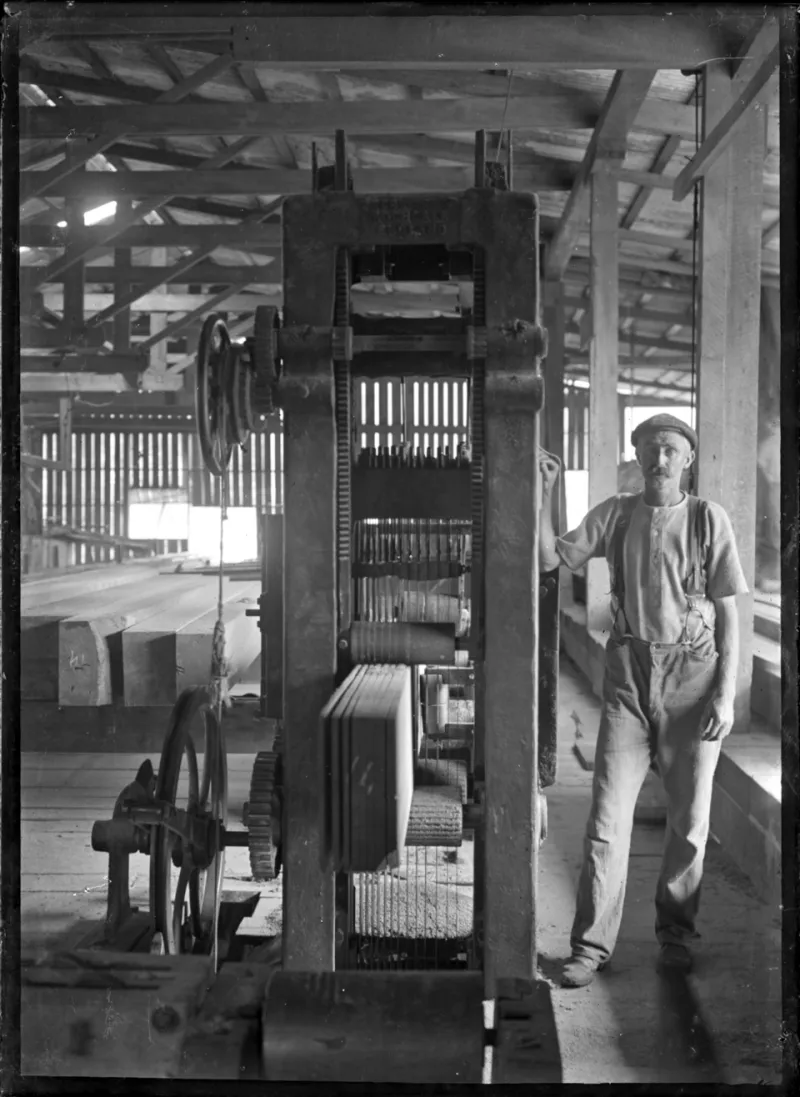
Photo: Godber, Albert Percy, 1875-1949, Public domain, via Wikimedia Commons
There is a particular kind of silence that falls over a woodyard when a customer comes back with a wrapped bundle of decking that has gone full banana in the garden. Nobody enjoys it. The yard loses a sale, you lose a weekend, and the timber goes on the fire either way.
Almost all of that grief is avoidable in the five minutes before you pay. You do not need a moisture meter, a micrometer or a qualification. You need a straightedge of some sort, one hand and a bit of patience. Here is the order we would work in.
Do it before it is cut, wrapped or loaded
Once a board is crosscut, planed or strapped to a pallet, you have made it yours in the eyes of most yards. That is not sharp practice, it is just how stock works. So the time to push back is at the rack, while the board is still one of forty identical-looking ones and swapping it costs the yard nothing but a walk.
Take your time. Ask for the pack to be broken if you need to. A good counter would rather see you sight down six boards than take a phone call in three weeks.
First pass: stand at the end and look down the length
Sight along the board like you are looking down a fence line. You are looking for four shapes, and they are not equally bad.
Cup is a curve across the width, so the board looks like a shallow gutter. It is the enemy of anything that has to sit flat and be seen: decking, fascia, worktops, shelf boards, flooring. In a fence rail or a bit of hidden framing, a mild cup is forgettable.
Bow is a curve along the length, so the board rises in the middle like a stretched bow. In a stud wall, a bowed stud can be pulled into line with noggins and plasterboard. In a floor joist, bow means a floor that dips and creaks and a lot of unhappy work later on. Grade rules do allow a bit, but you want to know about it before it is in the ceiling.
Twist is the nastiest of the four, and the one most people miss. The corners do not sit in the same plane, so one end of the board is trying to go left and the other end wants to go right. Twist is grim in door linings, gate frames, table tops and anything fixed at both ends, because the fixings fight the timber permanently. A slightly twisted board will win that fight eventually.
Spring, sometimes called a sweep, is a gentle sideways curve when you look at the face. Harmless in short cuts, annoying in long runs of skirting or cladding where the line has to stay true.
Second pass: lay it down and rock it
There is a trick from furniture workshops that works just as well in a yard. Lay the board on something flat and solid, then press on opposite corners. If it rocks, you have found twist. Press the other pair to confirm. Any board that refuses to sit on all four corners on a flat slab will refuse to sit on your wall too.
Third pass: put a straightedge on it
A two-metre aluminium rule, a taut string line or simply another board you already trust. Check one face and both edges, because a board can be straight on the face and bent on the edge, and it is often the edge that matters for a joint.
There is no magic number, but as a rough working rule a couple of millimetres of gap over two to three metres is normal and workable. If you can slide a finger under the rule, that board is doing something you will have to design around.
Splits, shakes and the ends
Look hard at the ends first, because that is where drying stresses show up. Small end checks are common and mostly cosmetic if you have length to cut back, but a split running more than a hand's length into the board is a warning, especially if it lines up with where you plan to fix or joint.
Shake is different from a check and worth knowing about. It is a separation running along the growth rings, often invisible until you see a fine dark line down the face or the end grain parts like a book. Shake weakens timber in a way that cutting back does not fix. In structural sizes, walk away.
One honest exception: green oak will check at the ends, and that is expected behaviour, not a fault. If you are buying air-dried or green oak for a frame, plan for it.
Knots: position beats quantity
A tight, live knot with the grain flowing round it is part of the character of the timber. A dead knot, dark and ringed, with a crack around the edge, will fall out and leave a hole, usually in the most visible place on the job.
What matters more than the number of knots is where they sit. A knot in the middle of a short rail, a step string or a ladder-style frame is a weak spot. A knot on the edge of a board will unwind and let moisture in. If the timber is strength-graded and stamped, trust the stamp, but still glance over the load-bearing pieces yourself.
Weight, colour and the palm test
Pick up two boards from the same pack and compare. The heavy, cold, darker one is carrying more water. Wet timber is not a scam, it is just a fact of supply, but it matters: wet treated timber will shrink, cup and gap as it dries on your wall, and wet decking laid tight will open up at every join by the end of summer.
Ask what moisture content the stock is at, and whether it has been kiln dried. If the answer is a shrug, buy the boards that feel lighter and look paler, and let them acclimatise before you fix them.
While you are looking, note any green or black staining. Blue sap stain is almost always cosmetic, but it tells you the pack has been sitting damp somewhere. Surface mould on a fence board you are going to nail up outside is not the end of the world. Mould on joinery-grade timber you are painting is a conversation.
When to ask for another board
Be specific and be pleasant. Not this looks rubbish, but this one has a twist in the middle and I need it flat for a door lining, could we have a look at another from the back of the pack. Yards deal with this every day and it is a two-minute job. If two or three boards in a pack are bad, ask them to break a fresh one, because the rest are likely to be from the same batch and the same log.
The flip side is worth saying too: do not reject a perfectly good board for a defect you are about to saw off. A bit of wane on the underside of a fence panel, a check on the end you will lose to a cut, a knot that ends up in the offcut bin, none of that is worth a standoff at the counter.
Five minutes, one straightedge, one pair of hands. Cheaper than a second trip.